Showing posts with label China. Show all posts

Friday, July 1, 2011

Railway to Tibet stands safety, environment tests


The Qinghai-Tibet Railway, the world's highest plateau railway, has stood safety and environmental tests while boosting regional economic growth over the past five years.
Friday marks five years since the railway opened.
The 1,956-km rail link running from Golmud in the northwestern Qinghai Province to Tibet's regional capital Lhasa has transported more than 41 million passengers and 180 million tonnes of cargo since it opened on July 1, 2006, sources with the railway operator said Thursday.
Last year, the railway carried 9.7 million passengers and 48 million tonnes of goods, compared with 6.4 million people and 24 million tonnes of goods in 2006, said Miao Xiaohua, deputy manager of Qinghai-Tibet Railway Company.
Tibet Autonomous Region received 6.8 million tourists in 2010, 3.8 times the 2005 figure, said Wang Songping, Tibet's deputy tourism official.
"Last year, 42 percent of the tourists traveled by train, a sharp rise from 26 percent reported in 2006," Wang said.
By the end of 2015, Tibet expects to host 15 million tourists annually and post an annual tourism revenue of 18 billion yuan (2.8 billion U.S. dollars), he said.
ADDRESSING ENVIRONMENTAL CONCERNS
The Qinghai-Tibet Railway passes through three national nature reserves including Hoh Xil, a major habitat for the critically-endangered Tibetan antelope.
Perched at an average altitude of 4,500 meters, Hoh Xil reserve contains the largest area of uninhabited land in China and is dubbed the country's "last haven for wild animals."
Pregnant antelope cows, often followed by young members of the herd, migrate to Hoh Xil every June to give birth, and leave the reserve in September.
"The number of antelopes that make the migration has apparently risen in recent years," said Xiao Penghu, deputy chief of Hoh Xil Nature Reserve Administration.
Xiao said some people had thought the roaring trains might scare away the antelopes and disrupt their breeding pattern, but in fact their population in the Hoh Xil region had increased from around 50,000 in 2006 to more than 60,000 currently.
Thirty-three special passageways were built along the Qinghai-Tibet Railway enabling animals to follow their normal migration routes unhindered.
"I see herds of Tibetan antelopes going through these passageways every summer," said truck driver Li Jingui who drives along the route every year.
The Qinghai-Tibet Plateau used to have millions of Tibetan antelopes, but hunting and destruction of their habitat had decimated the population over the past decades.
Poachers hunt the antelopes for their hides as it can be sold and made into shahtoosh shawls, a luxury item that requires three to five antelope skins to make just one shawl.
Since 1979, the animal has been recognized as an endangered species and protected under the Convention on the International Trade in Endangered Species.
"We've been watching out for potential pollution all these years," said Wang Zhiwei, a maintenance engineer with Qinghai-Tibet Railway Company.
Wang and his colleagues monitor all the 15 sewage treatment stations along the Golmud-Lhasa section of the railway every month to ensure sewage is treated properly and causes no pollution to the plateau air and water.
All the stations use clean energy to minimize emissions.
Meanwhile, railway authorities have worked to preserve and expand vegetation along the route, which is surrounded by 675 km, or 5.6 million square meters, of trees.
In 2008, the railway was named as an "environment-friendly project," China's top environment award.
SAFE OPERATION
Before the railway was built, people questioned its safety, fearing the permafrost along the route could never support tracks and trains and lack of oxygen could be fatal for the workers and passengers.
"After five years of operation, we have observed no changes in the frozen earth along the route," said Wang Zhiwei.
Ministry of Railways, Ministry of Health and the local governments and Qinghai and Tibet have worked effectively to prevent altitude diseases and the rat plague.
"No railway worker died of altitude disease and no rat plague had spread in the trains to and from Lhasa over the past five years," said Miao Xiaohua, deputy manager of the Qinghai-Tibet Railway Company.
Meanwhile, all the passengers who fell sick during the journey received timely treatment, he said.
ECONOMIC BOOM
The railway to Lhasa has proven effective in boosting the overall development in both Qinghai Province and Tibet.
Official figures show Qinghai's GDP soared from 64.1 billion yuan in 2006 to 134.2 billion yuan last year.
Meanwhile, Tibet's GDP rose from 34.2 billion yuan to 50 billion yuan, an average annual growth of at least 10 percent.
The railway has brought a surge of tourists, giving a boost to the local tourism and hospitality industries.
La Xuecai, a Muslim Hui who runs a restaurant in a remote town near Hoh Xil, said the railway had turned the formerly obscure place into a "boom town."
Tibetan businessman Tobgye said the surge of tourists following the railway's opening has brought a business boom for his theme restaurant in Lhasa that features Tibetan food and folk art performances.
"Many of my Tibetan friends and neighbors are also benefiting from the railway, running home inns and eateries."
The rail link to Lhasa is a starting point towards a more comprehensive railway network in the underdeveloped western China.
An extension of the railway from Lhasa to Xigaze, Tibet's second largest city, began last year and will be completed before the end of 2015.
Tibet will start building another extension of the plateau railway, from Lhasa to Nyingchi, in the next five years, according to the region's plan for economic and social development in the 2011-2015 period.

source: china.org.cn

Tuesday, November 23, 2010

China plans SE Asia rail links


China is planning high-speed rail links with its Southeast Asian neighbors, namely, Myanmar, Cambodia, Thailand and Laos, and further expand its economic and strategic regional influence.
China's national rail network, which is already the world's biggest, will reach 120,000 km by 2020. Sixty percent of the railway lines will be located in the western regions, which have historically lagged the coastal east on most development indicators.
In two months, work will begin on a 1,920-km high-speed rail line connecting south-western Yunnan province with Yangon in Myanmar, with trains running at over 200 km/h, the official China Daily reported on Monday.
Studies were also under way to link Yunnan's capital Kunming with Cambodia, Laos and Vietnam, the daily quoted Wang Mengshu, one of China's leading railway consultants, as saying.
In August, China's Ministry of Railways also sent a team to Thailand to explore investing in a $25.6 billion, 240-km high-speed railway and rail network.
Wang had earlier said that the Southeast Asian network could be completed as early as 2020.
Authorities in Beijing hope the investment in Southeast Asia will also ease anxieties among its ASEAN (Association of Southeast Asian Nations) neighbors over the impact of China's rising economic influence.

source: Press tv

Thursday, November 11, 2010

Beijing-Shanghai high-speed railway may open next October


Track construction for the Beijing-Shanghai high-speed railway in Jiangsu Province and Shanghai has been finished ahead of schedule, drastically shortening the planned construction time, which means it is possible for the high-speed railway to open by the National Day on Oct. 1, 2011, according to sources from the Ministry of Transportation.
The construction of the 1,318-kilometer-long Beijing-Shanghai high-Speed railway began in March 2008. The railway adopts ballast-less tracks that are already used on the Shanghai-Nanjiing Intercity Railway. The 500-meter-long tracks are welded together so there will be no gaps on the 1,318-kilometer-long track. This guarantees a smooth and comfortable ride for passengers.
After open to traffic, a ride from Beijing to Shanghai will take just four hours, 10 hours less than the current time. It will transport more than 80 million passengers on the one-way railway one year.
The high-speed Railway is compatible with the 200-kilometer-long existing railway, which allows trains running at 200 kilometers per hour or above use the high-speed railway too.
Sources said a new-generation bullet train that will travel up to 380 kilometers per hour is now under development for the high-speed rail link.
The high-speed railway between China's two most important metropolises is part of China's ambitious high-speed railway program. Ministry of Railways Vice-Minister Wang Zhiguo said China will complete an 110,000-kilometer railway network by 2012, including 13,000 kilometers of high-speed rail.
Ultimately, China plans to construct a 120,000-kilometer railway network, including 50,000-kilometers of high-speed rail track, by 2020.

source: People Daily

Thursday, November 4, 2010

China rides bullet train to Poland


Chinese railway firms are laying tracks straight to Poland, looking to sell high-speed train technology to the European nation.
A delegation of eight major companies from the high-speed rail industry are slated to visit Warsaw in mid November, the Ministry of Railways said.
Together the companies boast they have the technology needed to build a high-speed railway, including train design, train production, railway building and signal services.
Ye Juan, a member of the ministry's China-Poland Coordination Group, told the Global Times that the Warsaw delegation includes high-ranking officials from the respective companies.
"Therefore, during the promotional (meetings), it is possible that agreements could be reached," Ye said.
In a move that will likely sweeten the political atmosphere for the delegation's arrival, Chinese Vice President Xi Jinping arrived in Poland Tuesday to boost economic ties.
"Though our program is held separately, I think his visit could be favorable for our program," Ye said.
Demand for Chinese railway technology is growing in Eastern Europe, as the technology is reasonably priced when compared with German and Japanese rivals.
"China's economy is very strong now, and the technology is good quality and competitively priced," said Witold Prandota, minister counselor of the Polish embassy in Beijing.
Prandota, speaking to the Global Times yesterday on the sidelines of the China-Poland Investment Seminar in Beijing, put it simply, saying, "China's offer, from a professional point of view, is the best."
The eight company delegation heading to Poland includes the China Academy of Railway Sciences, the Third Railway Survey and Design Institute, CSR Corporation Ltd, China CNR Corporation Ltd, Huawei Technologies, the China Railway Construction Corporation, the China Railway Signal and Communication Corporation and the China Railway Group.
Earlier this year, CSR Corp went to the US state of California and bid on a high-speed railway project.

source: Globaltimes

China launches international high-speed rail project


"[Creating] the corridors of an international railway is expected to put on the agenda," said He Huawu, an academician of the Chinese Academy of Engineering and chief engineer of the Ministry of Railways (MOR), according to the 60th anniversary of China Zhongtie Major Bridge Reconnaissance and Design Institute.
China has 10,000 kilometers of high-speed railway under construction at present, including the Beijing-Harbin, Harbin-Dalian, Hefei-Fuzhou, Beijing-Wuhan, Shanghai-Ningbo and many other lines. The government plans to add 4,613 kilometers of new lines.
China's high-speed rail networks had developed rapidly as independent technological innovation based on existing technologies helped the country make trains that could travel up to 350 kilometers per hour, He said.
Chinese companies had sought cooperation with their foreign partners including Siemens, Bombardier and Alstom.
China opened its first high-speed rail line linking Beijing and Tianjin in 2008 in cooperation with Germany-based Siemens.
France's Alstom has bid in March to supply locomotives for the world's fastest rail line in China as it also considered offering high-speed train maintenance services to China.
China will host the World Congress on High-Speed Rail for the first time when the event is held in Beijing from Dec. 7 to Dec. 9 in Beijing, He said.
The MOR will co-host the congress with the UIC (International Union of Railways). The past six congresses were all held in Europe, He said at a press conference.
China already has the world's biggest high-speed rail network with 6,920 kilometers of lines in operation.
By 2012, China would have a railway network of 110,000 kilometers, of which 13,000 kilometers would be high-speed lines.
Trains traveling at up to 350 kilometers per hour, including the Beijing-Tianjin, Wuhan-Guangzhou, Zhengzhou-Xi'an and Shanghai-Nanjing services are already the fastest in the world.
In addition, China will build more cross-Sea Passages, and some preliminary studies have been carried out. In the long run, some international corridors may also be put on the agenda, including the Central Asia channel, North-East Asia Channel, Southern Asia Channel, Pan-Asian channel. These major projects will introduce new technology and higher requirements in bridge engineering.

source: People Daily

Tuesday, October 26, 2010

China unveils Shanghai-Hangzhou high-speed railway; eyes network extension


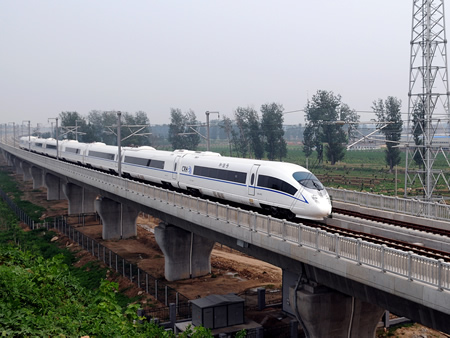
SHANGHAI/HANGZHOU, Oct. 26 (Xinhua) -- High-speed trains began traveling between the eastern Chinese cities of Shanghai and Hangzhou Tuesday morning, the latest milestone in China's effort to build the world's fastest rail network.
Two bullet trains equipped with China's CRH380A system simultaneously took off at 9:00 a.m. Tuesday from Shanghai's Hongqiao Station and from Hangzhou Station.
Trains on the line will travel at an average speed of 350 kilometers per hour, shortening the trip between to 45 minutes from 78 minutes.
After 20 months of construction, the 202-km high-speed railway linking Shanghai, China's economic hub, and Hangzhou, capital of east China's Zhejiang Province, extends the nation's in-service high-speed rail network to 7,431 kilometers.
Earlier last month, the Shanghai-Hangzhou high-speed line stunned the world when in a trial run, a train hit a speed of 416.6 kilometers per hour, a world train speed record.
"The operation of the Shanghai-Hangzhou high-speed rail line will help alleviate traffic pressure in the Yangtze River Delta region," Liu Zhijun, Minister of Railways, said at the line's inauguration ceremony.
"It will not only promote economic and personnel exchange but facilitate the integration of the Yangtze River Delta region as well," Liu said.
According to Ministry of Railways (MOR) forecasts, passengers are expected to make 3.05 billion trips in and out of the Yangtze River Delta in 2010, with the figure jumping to 5.5 billion in 2020.
A ticket price for the nine-stop trip between Shanghai and Hangzhou costs 156 yuan (23.4 U.S. dollars) for a first-class seat and 98 yuan (14.7 U.S. dollars) for a second-class seat.
China launched its first high-speed line - a service linking the capital and the port city of Tianjin - during the Beijing Olympics in 2008.
Since then, more fast-train lines have been put into service: the Wuhan-Guangzhou line linking central and south China; the Zhengzhou-Xi'an line connecting central and western China; and the Shanghai-Nanjing line in the country's east.
China has an ambition to make its high speed rail network the world's longest.
According to the MOC, China will have a rail network of 110,000 km by 2012, with 13,000 km of it high-speed rail.
The highlight of China's high-speed rail network will be the 1,318-km Beijing-Shanghai line. Currently under construction, the 220.9 billion yuan (33.1 billion U.S. dollars) line is scheduled to open in 2012.
Once complete, train travel time between the country's two most important cities will be cut in half to less than five hours.

source: xinhuanet

Thursday, October 21, 2010

China, Thailand foster high-speed link


BANGKOK - Thailand and China have agreed to proceed with rail connections that will connect the two countries through neighboring Laos. The planned links aim to enhance rising trade flows sparked by the new China-Association of Southeast Nations (ASEAN) free-trade agreement and facilitate with modern infrastructure the region’s move towards a common ASEAN market.
Thai Prime Minister Abhisit Vejjajiva emphasized his government's plans for new logistical and infrastructure projects, with rail expenditures prominent among them, during a roadshow in New York in late September. He said in a speech that his government had approved a framework for Thailand-China cooperation in building a high-speed train route connecting Thailand's poor northeastern region through the Thai border town of Nong Khai to China.
The plan also calls for high-speed routes connecting Nong Khai to Bangkok and then eastwards to the industrially driven Thai Eastern Seaboard, with a third line linking the capital to the country's southern region near the Malaysian border at Padang Basar.
"These high-speed trains will not only facilitate the rapid movement of goods and people, but will provide even more benefits to Thailand once ASEAN becomes a single market and Thailand becomes a stronger production base for the Economic Community," Abhisit said.
The three confirmed routes will connect to a conventional railway China is building to its southern border and across Laos. Beijing has provided concessional loans for that link, although no sums or timetables have been mentioned for the project, which will go from Vientiane, the Laotian capital, to Boten near the Chinese border in Luang Namtha province in northern Laos. Lao Minister for Planning and Investment Sinlavong Khouthphaythoune is pushing for the link to be built within five years, according to official media.
Once these missing links are in place, China's existing rail network will become connected to Thailand and eventually onward south to Malaysia and Singapore. Beijing believes its all doable within three years; Thai politicians are more cautious. "If there is any delay, I suspect it will be at our end, not theirs," said Thai Finance Minister Korn Chatikavanij over the summer.
His guarded timetable speaks to the projects' still many unanswered questions, including the role of Chinese finance and labor in building the new lines. "The main issue is the missing links. The other is money," said Pierre Chartier, economics affairs officer at the United Nations Economic and Social Commission for Asia and the Pacific's transport and tourism division.
Chartier also looked beyond the China-Thailand connection.
"There is no physical rail connection between China and Laos, China and Myanmar, Myanmar and Thailand, Thailand and Cambodia, Cambodia and Vietnam, Vietnam and Laos. There's a lot of work to do" said Chartier. "The good news is that all feasibility studies have been completed."
It's still unclear whether Bangkok will accept Chinese export credits or government soft loans to help fund the estimated US$10 billion railway projects. Such financing is usually conditional on accepting Chinese labor - a condition that makes sense in technically challenged countries like Laos, but less so for Thailand's more developed work force.
Noting that some 64,000 Chinese workers are working on the railroad in Laos, one State Railway of Thailand official chafed at the suggestion that even 100 Chinese engineers be dispatched to Thailand for the project.
"We're actually working to try and create jobs for Thai people and Thai engineers, to develop our own expertise," said the official. "I don't believe that [bringing Chinese workers in Thailand] will be done easily."
There are also inter-operability concerns. "Most Southeast Asian countries are developing meter gauge. Whether they are going to move to a standard gauge like they have in China is difficult to say," said Chartier.
Some of the feasibility studies, he said, include plans for the track to have an envelope large enough to accommodate later changes if necessary. That embeds higher logistical costs to trade, as China is incurs with Mongolia where inconsistent gauges mean ore exports must be loaded into new train cars at the border.

Interlinking uncertainties
The bigger question surrounding Thailand's plans are of commercial viability. Thailand's Office of Transport and Traffic Policy and Planning, which foresees four rather than three high-speed rail lines, projects daily passenger numbers of 128,000 by 2017, rising to 192,000 in 2032. Those projections fail to indicate with specifics the projects' target market and whether passengers in poor regions will be able to afford the ticket prices that will need to be charged to re-coup the sizable running costs and capital investments.
The project's cargo-moving potential makes more economic sense. However, analysts note that most cargo does not require high-speed lines unless it is of exceptionally high value, including components used in just-in-time manufacturing processes. They say cargo volumes generally require a decent but not breakneck speed and reliability. Identifying exactly what cargo will be moved in relation to the current and future needs of Thai industries is key to justifying the investment in high-speed lines, they say.
The Thai side is beset with political problems that could eventually derail Abhisit's plans. His coalition government is unstable, and pushing major infrastructure spending into the geographical territory of the political opposition raises political risks before a general election due by the end of 2011. Already one of the opposition parties, Pheua Thai, has questioned the lack of transparency surrounding the plans.
The crucial implementing decisions will likely be made by the next elected government. Either way, it will face a tough internal test from the Thai bureaucracy, which has become reluctant to sign off on big-ticket infrastructure projects on the fears of officials that with a change in government they could be prosecuted for corruption - as happened to certain officials after the 2006 military coup that ousted premier Thaksin Shinawatra.
Part of the problem is Thailand's mixed track record with so-called public private partnership (PPP) investment schemes. Some have made money while others have incurred losses, including expressway projects in Bangkok. Deputy finance minister Pradit Phataraprasit recently acknowledged, "Historically, we have not been able to leverage PPPs well."
Other countries in the region, including Cambodia, are moving more quickly with an eye towards greater regional connectivity. A southern 240-kilometer line running between the Cambodian capital of Phnom Penh to the deepwater port of Sihanoukville is expected to start operations next May, said Peter Broch, senior transport economist with the Asian Development Bank (ADB).
It is one of two major rail restoration projects underway in Cambodia - the second being a 350-kilometer northern line that will link Phnom Penh to Poipet, just across the border from the Thai town of Aranyaprayet. Work on the line is due to start "very soon, right after the rainy season", said Broch, who predicted a May 2012 completion date. Together the two re-established lines will cost US$142 million, with the ADB leading and Australia's international aid agency, AusAID, contributing $25 million of the sum.
However, other high-speed rail ambitions recently came undone in Vietnam amid rising market concerns about the country's financial management. A proposed $56 billion north-south line that aimed to reduce rail
travel times between the capital, Hanoi, and the commercial hub of Ho Chi Minh City from 30 hours to six ran into resistance and was scrapped on the drawing board by the National Assembly.
Others see a more hopeful model in Malaysia. The country's national railway company, Keretapi Tanah Melayu Berhad (KTMB), operates commuter, inter-city and freight services on peninsular Malaysia and has held its commercial own amid a rapid expansion in car ownership. While passenger numbers roughly halved from 7.6 million to 3.7 million from 1992-2007, freight loads rose from 3.6 million tonnes to 4.7 million tonnes over the same period.
KTMB notes that total tonne kilometers, a measure of both freight and passenger loads, rose from over 1 billion to 1.4 billion over the same time. KTMB is now pursing a strategy of mixing consolidation and growth, according to chairman Tan Sri Dato' Sri Lim Ah Lek.
Thailand's grand plan would eventually link with Malaysia through high-speed lines, creating a north-south link that reaches to China. As Asian economies look more towards regional rather than Western trade for future growth, it's a forward-looking plan with the potential to position Thailand as a highly efficient regional hub connecting China to Southeast Asia. But politics and nationalism could yet derail those economic ambitions.

source:
Asia Times

Tuesday, October 19, 2010

China high speed railway tracks cover 7055 kilometers in Sept


According to Mr He Huawu chief engineer of Ministry of Railways that China high speed railway covered 7,055 kilometers as of September 30 and 10,000 kilometers of high speed railway tracks are under construction.
China currently has 377 EMUs that operate at speeds of 250, 350 and 380 kilometers per hour.
He estimates total track coverage of China’s high speed railway system will hit 50,000 kilometers in the next few years and will connect all cities with populations over 500,000.


source: Steel Guru 

China starts to develop new generation of high speed train


A train runs on Shanghai-Hangzhou High-Speed Railway during its trial operation, in Shanghai, east China, Oct. 18, 2010. The train CRH380A, setting a new speed record of 416.6 kilometers per hour, will make its debut operation officially at the end of this month. The ticket prices and the operation time table will be released this week.

China Railway Major Bridge Reconnaissance and Design Institute CO., Ltd. announced - during a ceremony marking 60 years since its foundation - that China has started to develop a new generation of high-speed train with a maximum operating speed of 500 kilometers per hour.
He Wuhua, with the Chinese Academy of Engineering, said in Wuhan, Hubei Province, that China is making efforts to study the systems dynamic of a high speed railway with a speed between 400 to 500 kilometers per hour.
The train CRH380A of the Shanghai-Hangzhou High-Speed Railway set a new speed record of 416.6 kilometers per hour during its trial operation in Shanghai on September 28.
China has the world's longest high-speed rail network with about 7,055 kilometers of routes in service as of last month.

source: Global Times

Railway tunnel collapse leaves 7 dead, 3 injured in north China


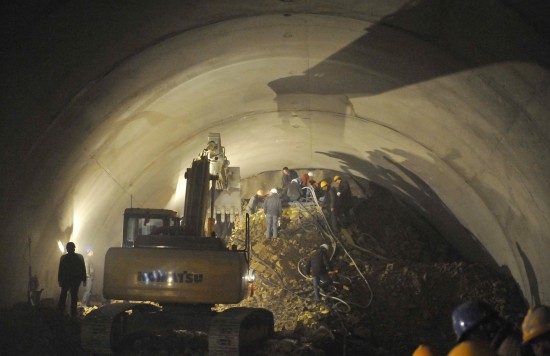
A railway tunnel under construction in north China's Inner Mongolia Autonomous Region collapsed Monday, killing seven workers and injuring three others, the local work safety bureau said Tuesday.
Four died instantly when the tunnel in Aohan Banner collapsed at about 3 p.m. Monday while three died later in hospital, a spokesman with the Inner Mongolia Autonomous Regional Administration of Work Safety said.
The three injured workers are being treated in hospital and are in stable conditions.
Local authorities are investigating the cause of the accident.
The 282 km-long railway line will link Chifeng in Inner Mongolia and Jinzhou in neighboring Liaoning Province. Construction on it began in January 2009.

source: People Daily

Sunday, October 17, 2010

Myanmar to construct railroad to link deep-sea port with China


Myanmar has planned to construct a railroad that will link a deep-sea port, Kyaukphyu, in western Rakhine state with Kunming, southwest of China, the local Weekly Eleven News reported Saturday.
The Kyaukphyu-Kunming railroad, which is part of the Kyaukphyu- Ruili platform project and national railroad network, is targeted to be finished in 2015.
The railroad will pass through Rakhine State, Magway Region, Mandalay Region and Shan State in Myanmar, the report said.
The railroad project is divided into such sections as Kyaukphyu- Eann-Minbu, Minbu-Magway-Mandalay-Lashio-Muse and Muse-Jiegao trans-border railroad.
After the project is implemented, Myanmar's Shan State and China's Yunnan province can be connected directly and the railroad will mainly facilitate the goods flow from China, the report said, adding that Magway and Mandalay regions will then become the main business towns.
Meanwhile, China has also planned to invest in a special industrial zone to be established in Kyaukphyu.

source: People Daily

Saturday, October 16, 2010

Turks, Chinese to build high-speed train lines across Turkey


Turkish and Chinese companies will jointly construct high-speed train lines in Turkey, Turkish State Railways, or TCDD, Director General Süleyman Karaman said Friday.
Under an agreement signed between China and Turkey last week, China will grant loans for the construction of a Silk Road Railway of high-speed train lines between Edirne and Kars.
"We are planning to construct lines for high-speed trains between Ankara-Izmir, Ankara-Sivas, Sivas-Erzincan, Erzincan-Trabzon, Sivas-Malatya, Elazig-Diyarbakir, Eskisehir-Antalya and Konya-Antalya," Karaman told journalists.
"We need $45 billion for Turkey's target to construct 6,000 kilometers of high-speed tracks and 4,000 kilometers of conventional railroad tracks by 2023. Within the scope of the agreement signed with China, this country will finance $28 billion of this target," Karaman said.
Karaman said China was planning to construct 2,000 kilometers of railroad tracks both in and outside the country, noting that China was carrying out many projects in Libya, Algeria and the United States with this goal.
Karaman said China was working to create a market in European countries and to this end considered Turkey an area to promote itself.

Sunday, October 10, 2010

Lhasa-Shigatse railway overrides serious issues


(TibetanReview.net, Oct09, 2010) Touted as a project to further develop Tibet, the Lhasa-Shigatse extension of the Qinghai-Tibet Railway, for which China began the actual building work on Sep 26, raises a host of technical, socio-economic, environmental, and geopolitical issues, according to The Economist Online (UK) Oct 7.

The report began by saying that in going ahead with the decision to build the railway line, the authorities appeared to have been undeterred by the problems that the railway had already brought to Lhasa where a tourism boom and a flood of immigrants from China’s interior contributed to an explosion of unrest among embittered Tibetans in Mar’08.

On the technical difficulties in building and maintaining the extension line, the report said that nearly half of it will go through tunnels or over bridges (96 of them). That it will cross areas prone to earthquakes, landslides and sand storms. And while the Golmud-Lhasa line had to traverse unstable permafrost, the Lhasa-Shigatse extension will be challenged by geothermal fields with hot springs. All this at an oxygen-starved altitude of 3,550-4,000 metres.

Even without the extension line and the upcoming airport, the opening of the Lhasa railway in 2006 led to the  the number of tourists who visited the Tibetan side of Mt Everest, located in Shigatse, had almost doubled to 27,476 in 2007 from the preceding year. This has the environmentalists are worried.

The extension line is also a matter of concern to India, given the railway’s role in transporting troops and military equipment. It will also give China more leverage and influence over Nepal. China’s long-term plans to further extend the railway network to Nyalam on the border with Nepal and to Dromo near Bhutan and the Indian state of Sikkim and to Nyingtri, located close to the Indian state of Arunachal Pradesh, claimed by China as southern Tibet, will only worsen the situation. Besides, Nepal has been repeatedly urging China to bring the railway right up to Kathmandu.

Shigatse itself is already a Chinese overwhelmed city. The report cited Tibet Business News, published from Lhasa, as saying that the majority of traders in Shigatse, Tibet’s second city, were already migrants from beyond Tibet. It was reported to cite a woman from neighbouring Sichuan Province as saying the railway would cut her costs of doing business in Shigatse by half. More Chinese like her will surely beeline for Shigatse and neighouring Tibetan towns as the Lhasa-Shigatse railway line progresses.