Showing posts with label US. Show all posts

Tuesday, November 23, 2010

JR Tokai vies for Florida rail system


NAGOYA (Kyodo) Central Japan Railway Co. (JR Tokai) plans to apply for prebidding screening to build a high-speed railway system in Florida, company officials said Monday.
The railway will join forces with 11 other Japanese firms so it can gain an advantage over its European and Asian rivals in pitching its shinkansen system, they said. The application is likely to be submitted this month.
The company wants the contract in Florida to act as a springboard for expanding the shinkansen system globally. Florida plans to construct a 130-km rail line between Tampa and Orlando at a cost of more than $2 billion, or about ¥160 billion. The project is getting federal funding.
Florida is expected to start prebidding screening this month to appraise the technical capabilities and finances of the bidders, which are expected to include companies from Germany, France, South Korea and China. It will likely narrow down the field to four groupings by February, before formally accepting bids around next summer.

source: Japan Times

Wednesday, November 17, 2010

National Express keen to operate US high-speed trains


National Express is engaged in discussions in the US about becoming the operator of a high-speed train route across Florida. The subject of the talks is a link between Orlando and Tampa, the first high-speed rail link to be built on this scale in the US. If National Express does become the route’s operator it is highly likely it will also be in charge of line maintenance.
Rail division Managing Director at National Express, Andrew Chivers, confirmed that the company had been talking to a number of consortia about joining them to operate the service. Chivers added that because the scheme had already been granted most of the $2.5 billion needed through a stimulus fund, there was probably no need for any additional equity investment in the project.
Any of the remaining money would probably be debt funded, Chivers went on to say. Of all the high-speed projects being mooted in the US, the Florida link is currently the most likely to get the green light. There are currently plans to build a rail link between Los Angeles and San Francisco in California. However, the state’s current financial problems will probably mean further development will be postponed for a while.
A motorway joining Tampa with Orlando will provide much of the land needed for the high-speed link. Built in the 1990s, a central reservation was included which will be able to accommodate the train line.
A second phase to link Orlando with Miami is still in the planning stage but has received $8 million worth of funding for a feasibility study.

Friday, November 5, 2010

Outgoing Wis. gov. suspends high-speed train work


Outgoing Wisconsin Gov. Jim Doyle's administration has asked contractors to suspend work on a high-speed rail line from Madison to Milwaukee while it studies the potential impact of stopping the project.
Department of Transportation Secretary Frank Busalacchi (boos-uh-LAH'-kee) said the suspension would last while the agency studies "the real world consequences, including the immediate impacts to people and their livelihoods, if this project were to be stopped."
The statement comes two days after Republican Scott Walker was elected governor to replace Doyle, a Democrat.
Walker has vowed to follow through on his campaign promise to kill the $810 million project, which is to be funded by federal stimulus dollars.
Busalacchi says the suspension will last "a few days."

Thursday, November 4, 2010

Cuellar announces $5.6 Million for Planning New Passenger Rail Line in South Texas


Congressman Henry Cuellar (TX-28), along with the Texas Democratic delegation, announced that the Department of Transportation has awarded Texas and Oklahoma a $5,600,000.00-grant as part of the High-Speed Intercity Passenger Rail Grant Program.
These funds will be used to complete necessary, preliminary corridor service planning studies for new and improved high-speed intercity passenger rail along an approximate 850-mile corridor, which mirrors the route of Interstate 35 between South Texas and Oklahoma City. The $5.6 million in planning funds will be shared with the State of Oklahoma, with Texas acting as the lead State.
Congressman Cuellar authored an amendment in H.R. 6003, the "Passenger Rail Investment and Improvement Act of 2008, to ensure that the South Texas community was included in the study. Now, initial planning will look at Laredo and McAllen/Brownsville as potential sites for a rail station. Prior to Congressman Cuellar’s amendment, the study would have only included areas north of San Antonio.
"Geographically, Texas is ideally suited for rail transportation and that’s why I fought hard to ensure that South Texas and the border community was included in this study," said Congressman Henry Cuellar. "A new passenger rail line would garner sizeable benefits for travelers as well as those in the trade community. This grant marks the kind of developments that will serve as the foundation for travel and commerce of the future."
Members of the Texas Democratic delegation, Reps. Eddie Johnson, Lloyd Doggett, Ciro Rodriguez, Solomon Ortiz, Ruben Hinojosa, Charles Gonzalez and Chet Edwards, welcomed news as well.
"With our highway system reaching capacity I’m glad to see Texas moving forward in developing a High Speed Rail infrastructure. These planning funds will allow the Texas Department of Transportation to begin planning for an intercity high speed corridor that would provide service from Laredo and Brownsville, to San Antonio and through Austin, Dallas, Fort Worth and onto Oklahoma City," said Congresswoman Eddie Johnson, the senior Texan on the House Committee on Transportation and Infrastructure.

Friday, October 29, 2010

Amtrak to buy 70 locomotives for $466 million


Amtrak is spending $466 million to replace 70 electric locomotives with new ones from German manufacturer Siemens, the president of the nation's intercity passenger railroad said Thursday.
The new locomotives will replace those in use on Amtrak's Northeast Regional route between Boston and Washington and Keystone route in Pennsylvania that are between 20 and 30 years old and have an average of 3.5 million miles each, Joseph Boardman told The Associated Press in an interview.
Siemens will build the locomotives at its plant in Sacramento, Calif., creating about 250 jobs, Amtrak officials said. Some work will also take place a Siemens plants in Norwood, Ohio, and Alpharetta, Ga.
The first delivery of new trains is scheduled for February 2013, Boardman said. The purchase will replace Amtrak's entire fleet of electric trains with the exception of Acela service locomotives. Acela is Amtrak - and the nation's - only high-speed passenger train service.
The new locomotives will be capable of operating at speeds up to 135 mph, but Amtrak doesn't plan to operate them at more than 125 mph, said Steve Kulm, a spokesman for the railroad.
The purchase is part of an Amtrak plan unveiled last February to replace and expand its entire fleet over the next 30 years. The company's first step in the plan, announced in July, was to spend $298 million to purchase 130 passenger cars.
"We need to upgrade the northeast corridor for the benefit of the businesses in the Northeast," Boardman said. "We have the financial capital of the world, we have one of the major medical corridors, educational institutions, and even fashion industry that are depending upon a reliable system of intercity transportation."
Amtrak carried 28.7 million passengers - a new ridership record - in the 12 months ending on Sept. 30. That was up 5.7 percent over the previous year.
The growth was largely due to services demanded in the Northeast, Boardman said.
"These locomotives will be built in America using renewable energy and provide cleaner, more efficient movement of people on the most heavily traveled rail route in the country," said Daryl Dulaney, president and CEO, Siemens Industry, Inc.
Six of the older locomotives will be retained for possible service expansions.
 

Thursday, October 28, 2010

High-speed trains get new U.S. funds


NEW YORK (CNNMoney.com) -- The Department of Transportation awarded $2.4 billion Thursday for high-speed rail projects, though a lot more money is needed to make the project a reality.
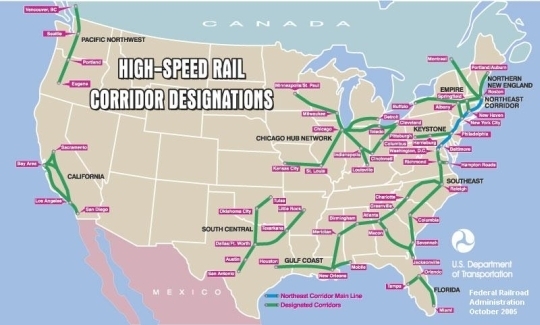
The lion's share of the grants went to California and Florida, according to the department. California is receiving more than $900 million, including $715 million to build a rail through the Central Valley, the nation's agricultural powerhouse. Florida will receive $800 million to build a high-speed rail from Tampa to Orlando.
Chicago is also being established as a major connector for the high-speed rail project. Iowa received $230 million to build a rail connecting Chicago to Iowa City and the Quad Cities along the Illinois-Iowa border. Michigan received $161 million to connect Chicago with Detroit.
In all, 23 states will receive part of the $2.4 billion .The money will go toward constructing the track and the stations, as well as new passenger equipment and the studies for developing high-speed service.
Demand for the federal funding is high. The Federal Railroad Administration, a division of the department, said it received 132 applications from 32 states totaling $8.8 billion.
However, the grants are a drop in the bucket compared to the estimated total cost. For example, Amtrak has estimated that a high-speed revamp of the Northeast Corridor, the most highly developed rail stretch, would cost $117 billion.
The Obama administration considers high-speed rail to be a necessary component in improving the nation's infrastructure to stimulate economic growth.
The Recovery Act passed last year has provided a down payment of $8 billion for high-speed rail funding, and the Department of Transportation provided more than $2.1 billion as part of its fiscal year 2009 budget.
In comparison, China's Ministry of Railways is investing $300 billion in its nationwide high-speed rail project, according to a World Bank report from July.

source: CNN

Chicago-to-Q-C rail link to operate by 2013


Illinois officials said Wednesday that Amtrak’s passenger rail link between the Quad-Cities and Chicago will be operational in 2013.
Scores of people gathered at Centre Station in Moline to celebrate the Obama administration’s announcement Monday that it would spend $230 million for an Amtrak link between Chicago and Iowa City.
The 2013 date is two years earlier than the target U.S. Sens. Tom Harkin, D-Iowa, and Dick Durbin, D-Ill., had announced earlier this week.
The Iowa City-to-Quad-Cities connection won’t be operational until 2015, officials say. But Illinois Gov. Pat Quinn told people Wednesday that it will be only three years before the Illinois trains begin to run.
Ray Lang, the senior director of government affairs for Amtrak, said track needs to be upgraded between the Quad-Cities and Wyanet, Ill., and a connection needs to be established there. But “if all goes well,” the service will begin in 2013, Lange said.
The newer start date was a surprise to many, including Paul Rumler, who is the executive director of the Quad-Cities Passenger Rail Coalition and has spearheaded local efforts to get passenger rail funding
 “That’s exciting news,” he said. “We were thinking initially the track construction would take two years.”
Quinn and Rep. Phil Hare, D-Ill., were the centerpiece of Wednesday’s event, which drew political and civic leaders from both sides of the river.
Both are in the middle of tough re-election battles, and the event comes less than a week before the election.
Neither made overt political pitches, but Davenport Mayor Bill Gluba, a veteran Democratic activist, drew a response when he bluntly said voters should keep in mind how the money got approved.
Much of the praise was directed at President Barack Obama.
“We owe a great deal of gratitude to our president,” Quinn said.
The money for the rail project was part of $2.5 billion the president requested to upgrade high-speed and intercity passenger rail connections in the country.
Already, Hare and U.S. Rep. Bruce Braley, who did not attend the Moline gathering, both have said top infrastructure priorities in the area are at risk if their opponents win on Tuesday.
Republicans Bobby Schilling, in Illinois’ 17th District, and Ben Lange, in Iowa’s 1st, have criticized the incumbents for overspending but have said they support infrastructure projects.
Schilling’s campaign said he was not available for an interview on the rail project Wednesday.
Cody Brown, the campaign manager for Lange, declined to comment on the project but said he would “work closely” with local leaders on infrastructure and transportation issues.
Today, Iowa Gov. Chet Culver and U.S. Rep. Dave Loebsack, D-Iowa, who also are facing re-election challenges, will appear at a similar event in Iowa City with U.S. Transportation Secretary Ray LaHood.

source: QC Times

Tuesday, October 26, 2010

California High-Speed Rail Program Gets Additional $902 Million


California Governor Arnold Schwarzenegger said the most populous U.S. state will receive $902 million in additional federal funds to help build high- speed passenger-train service.
The funds from the Federal Railroad Administration are on top of a $2.3 billion grant to the state in January as part of federal stimulus efforts, said Andrea McCarthy, a spokeswoman for Schwarzenegger. Details of the funds will be announced by the U.S. Transportation Department later this week, she said, without elaborating.
“As the nation’s largest infrastructure project, California’s high-speed rail system will create hundreds of thousands of new jobs, reduce pollution, boost economic growth and link Californians from one end of this great state to the other,” Schwarzenegger said today in a statement.
California’s push for a bullet-train network, which the state forecasts to cost more than $40 billion, comes as the state tries to reduce a 12.4 percent jobless rate and curb greenhouse gas emissions from cars and airplanes.
State voters approved a $10 billion bond sale in 2008 to help fund construction of the 800-mile rail network that is to operate trains between San Francisco and Sacramento in the northern part of the state to Los Angeles and San Diego in the south.
Rachel Wall, a spokeswoman for the California High-Speed Rail Authority, wasn’t immediately available to comment.

source: businessweek

Friday, October 22, 2010

High Speed Rail Project Set to Roll


TALLAHASSEE | Florida officials are still waiting for about half the money for a bullet train linking Tampa Bay to Orlando, but are about to begin advertising for bids for the first parts of the project.
The state Department of Transportation said it will begin advertising the first project, preparing the median of Interstate 4 for trains to run in it, in November.
Advertising for other contracts, including rebuilding two I-4 exits that will have to be rebuilt after the median is widened and moving a part of the highway near Orlando slightly west, will follow in December and January. In June, the department will solicit contracts for building a maintenance facility for the rail.
“The Early Works Projects will allow the FDOT to start preliminary construction on a fast-track basis, putting Floridians to work, while also creating an unobstructed corridor in which (Florida High Speed Rail Authority) construction by the Design, Build, Operate, Maintain and Finance Contractor can occur,” Adrian Share, senior vice president and program director of passenger rail for the newly formed Florida Rail Enterprise, and engineer Brad Flom said in a memo outlining the projects.
Share and Flom said the I-4 median would be widened in 12 places. A short list of possible firms to complete the work will be selected Dec. 14, and those companies will have to submit proposals by Jan. 25. The bids will be announced Feb. 21.
Florida was one of the biggest winners in the sweepstakes early this year for high speed rail money that was included in the federal economic stimulus, winning the second largest portion of $8 billion that had been set aside by Washington.

source: The Ledger

Tuesday, October 19, 2010

Amtrak Unveils 220 MPH High-Speed Rail Line Plan


NEW YORK – For New Yorkers who do business in Boston or Washington and want to get there in about 90 minutes without the headaches of air travel, Amtrak is hoping to make your dreams come true.
The company on Tuesday unveiled a $117 billion, 30-year vision for a high-speed rail line on the East Coast that would drastically reduce travel times along the congested corridor using trains traveling up to 220 miles per hour.
The proposal, which would require building a new set of tracks from Boston to Washington, D.C., is at the concept stage and there’s no funding plan in place, Amtrak President Joseph Boardman said at a news conference at Philadelphia’s 30th Street Station.
The project would likely use some combination of public and private investment and hopefully be phased in starting in 2015, he said.
“Amtrak is putting forward a bold vision of a realistic and attainable future that can revolutionize transportation, travel patterns and economic development in the Northeast for generations,” Boardman said in a release.
The Next-Gen High Speed Rail line would have hubs in Baltimore, New York City, Philadelphia and Washington and would cut travel times in half or better. It would reduce the travel time between Washington and New York from 162 minutes to 96 minutes, according to Amtrak. The travel time between New York and Boston would go from 215 minutes to 84 minutes.
About 12 million riders a year use Amtrak along the northeast corridor.
Under the high-speed system envisioned, the trains would be able to accommodate about 33.7 million passengers by 2040. Amtrak officials estimated the high-speed system would generate an $900 million more a year with the added ridership. Its construction would create more than 40,000 new jobs annually over a 25-year building period.
“Amtrak’s plan to modernize the Northeast Corridor and make it a truly high speed rail line is the type of innovative thinking we need to get cars off the road, decrease pollution and put people to work improving America’s infrastructure,” said Senator Frank Lautenberg (D-N.J.). “I applaud the plan and pledge to work with Amtrak to improve the Northeast Corridor and make a America a leader in high speed rail.”
High-speed rail would not only help reduce congestion on the rails, but also in the skies, since it would be more enticing to passengers making shorter trips, according to Amtrak officials and others.
“No one should take a plane for a trip shorter than 500 miles,” said Pennsylvania Gov. Ed Rendell, noting that the system would be comparable to service now linking European countries.
The Democratic governor added that political leaders must generate the will to get the project done before current system is overwhelmed.
“It isn’t a dream, it isn’t a fantasy, it isn’t an illusion,” Rendell said. “Can we afford it? … We can’t afford not to do it.”

source: IEWY

Sunday, October 17, 2010

Opinion: What the ARC rail project means for us


IN THE NEXT few days, Governor Christie will step before a podium to announce the fate of the Hudson commuter rail tunnel, a stunningly pivotal moment for New Jersey’s economic well-being and a decision that may help him ride an unlikely controversy to wider national renown as a two-fisted fiscal conservative.

Christie first killed the $8.7 billion tunnel project on Oct. 7, saying he couldn’t stick voters with cost overruns he pegged as high as $5 billion. Then the nation’s top transportation official, U.S. Department of Transportation Secretary Ray LaHood, hand-delivered ideas to him in Trenton for salvaging the tunnel. Christie ordered the project to continue winding down but gave a working group two weeks to review the Obama administration official’s ideas.

Two options

Politically, Christie can win two ways. Either he kills the tunnel entirely, or he forces economies and secures a promise that additional non-state funds will be found and construction resumes. The former order will be cheered by thrift-focused Republicans and the anti-spending Tea Party movement that has embraced Christie, the latter by New Jersey taxpayers.
Yet if he rejects LaHood’s blandishments, the state would be a monumental loser because it would be denied the biggest strategic investment in its economy since the Depression. The state would forego 6,000 local jobs that are important in today’s weak economy, and 44,000 permanent jobs in 20 years.
But the influence of the tunnel, formally known as the Access to the Region’s Core project, on New Jersey’s future cannot be overstated. With it, wealth from the financial capital of the world would radiate to cities and towns west of the Hudson River for generations to come, whereas without it, Christie condemns the state to perpetual status as the tri-state region’s poor country cousin.

Nation’s largest project

ARC is the largest public works project in the country, having been allocated some $200 million in funds under President Obama’s stimulus plan. As it was evolving for a decade, it enjoyed wide bipartisan support — Christie himself advocated it to Washington during his first months as governor.
But killing the tunnel earned national headlines and it ceased being a parochial New Jersey matter. During this heated congressional election season, the tunnel quickly came to epitomize the paramount national debate over how to cure the country’s stubborn economic ills — whether to prime the economy with public works spending or to cut spending at all government levels to the bone.
“Thanks to Christie’s stunning decision, the tunnel has become a symbol of what Republicans, especially Tea Party supporters, think of the stimulus and government spending,” said Larry Sabato, director of the University of Virginia’s Center for Politics. “Christie has defined the tunnel as bloated pork, though many beg to differ.”

Rather than pork, the tunnel is an energy-efficient platform for mobility in the 21st century.

It would double commuter rail capacity during rush hours between New Jersey and Manhattan, from 23 trains per hour to 48 trains, with its tracks going to a new station beneath 34th Street because Pennsylvania Station will be at capacity. So far $8.7 billion had been pledged — $3 billion from ARC co-sponsor the Port Authority of New York and New Jersey, $3 billion from the federal government and $2.7 billion in state funds.
Unless Christie changes his mind, however, the state loses the $3 billion in federal funds. The Port Authority would be free to recommit its $3 billion to road, rail and port facilities within the authority district, a 25-mile radius of the Statue of Liberty.
And if the tunnel dies, northern New Jersey and southern New York State have the most to lose. Over time, NJ Transit has been investing in links that gave Essex, Union, Morris and other counties direct service to midtown Manhattan, while telling people in 250 Bergen, Passaic, Rockland and Orange towns they must wait for the tunnel before they get fast, no-transfer rides to the city. Railroad officials would now have to tell them to forget it.

The next revolution

The tunnel is also a linchpin to the next revolution in passenger rail — the meshing of the New York region’s three commuter lines whereby trains run on one another’s tracks. New York’s Metropolitan Transportation Authority and NJ Transit planners foresee riders, for example, going from Ridgewood to Citi Field, from Westwood to the Hamptons, or from New Brunswick to New Haven, on one train and with one ticket. Without the tunnel, New Jersey does not participate in rail regionalization.
The possibility of ARC cost overruns were first raised in May by the FTA, about the time the federal agency was in final negotiations with the MTA on the price to complete the Second Avenue Subway and the Long Island Rail Road’s tunnel to Grand Central Terminal. The parties agreed these big N.Y. projects each risked costing $500 million more.

The MTA committed to all overages and construction never ceased.

NJ Transit has for five months been negotiating cost contingencies with the FTA that the state would be required to cover. On the day Christie killed ARC, NJ Transit issued a statement saying it had put forth a range of $8.7 billion go $10 billion and the FTA $10.9 billion to $13.7 billion. ARC planners said NJ Transit and the FTA should be permitted to negotiate a final price and work should proceed.

Completion in stages

LaHood’s ideas are being closely held. But planners say to save money, the project could be completed in stages and the tunnel completed by late 2018 as scheduled. A new rail yard in Kearney is just one feature that can be delayed to save hundreds of millions of dollars in initial costs.
Planners say Amtrak could become a project sponsor and a source of additional federal funds. If the new tunnel is built, Amtrak gets two more rush-hour slots through the existing 100-year old tunnel to Penn Station under agreement with NJ Transit.
“The tunnel is essential for Amtrak to add future service,” said Jeff Zupan of the Regional Plan Association. But, he said, Amtrak “doesn’t have any money.”
LaHood and FTA Administrator Peter Rogoff are said to have been surprised by the $11 billion to $14 billion estimate Christie used to kill ARC. He jacked up its cost by adding $775 million — the cost of a new bridge that carries the Northeast Corridor over the Hackensack River — to the $8.7 billion. But the bridge, which both Amtrak and NJ Transit use, is not a formal piece of the project.

Bringing Amtrak into the fold

The new bridge is needed to carry more trains to the tunnel to use its full capacity. Sources said LaHood could bring Amtrak into the fold and direct high-speed passenger rail funds to the bridge to benefit the national railroad but also help cover Christie’s higher ARC cost.
As to the governor’s future, he has been stumping around the country for Republicans who admire his credit-crunching reputation. Three days after he killed the tunnel, he won a Tea Party presidential straw poll in Virginia, beating Sarah Palin.
“The fact that he beat Sarah Palin, the patron saint of the Tea Party movement, is significant,” Sabato said.
Whatever he chooses to do with ARC, Christie will please many people and will be seen as a sharp political operator.
But reputations are fleeting, whereas should he build the tunnel, it will serve New Jersey for a long, long time.

source: Northjersey

Wednesday, October 13, 2010

Amtrak: more passengers on Chicago-St. Louis route


Saturday, October 9, 2010

US - Daley: Chicago needs high-speed train from downtown to O'Hare


Mayor Daley is back from his week-long trade mission to China and Korea more convinced than ever that Chicago needs a high-speed train from downtown to O’Hare Airport and that there’s enough interest from foreign investors to make it happen.
“They’re all interested. … Everybody’s interested. ... They  want to design it. They want to build it, operate and maintain it … with people working here,” Daley said Monday at an unrelated news conference at Columbus Park.
Asked whether he’s convinced the project will someday get done, the lame-duck mayor said, “Yes. Much faster.  Definitely. I firmly believe that. But, you have to work on the financial terms and agreements. ... It’s very complicated.”
Won’t foreign investors be somewhat reluctant to invest in massive Chicago infrastructure projects  when the only mayor they’ve ever known is leaving office and they don’t who will succeed him?
Not according to Daley.
“They have confidence in the business community. They have confidence in the history of Chicago. ... This is not one town represented by one person. I’m sorry,” he said.
“I’ve loved this. I’ve worked hard. But, there are many, many people who have made a commitment to build Chicago just as much as I have and they’ll continue to do that — generations of people. It’s not just those in politics and government, but those in the business community.”
In 2008, the CTA mothballed plans for express trains to O’Hare and Midway amid more than $100 million in cost overruns on the super-station that was supposed to be built downtown beneath Block 37.
At the time, Daley said he would search for a private partner to complete the station.
His latest plan — announced just weeks before he chose political retirement over the quest for a seventh term — is far more ambitious.
It calls for private investors to complete the station, lay the separate track down the Kennedy Expy. needed to make the trains express and to run the system in exchange for premium fares.
On Monday, Daley noted that his entourage hopped on a high-speed train at the Shanghai airport and arrived at a stop just outside downtown seven minutes later.
“You have to have a high-speed train from your international airport to downtown. ... That will rebuild our commercial market and our hospitality industry,” he said.
“Great cities have [a] high-speed train from the airport downtown. ... Once you make that contact from the airport downtown, it keeps building your downtown  businesses, jobs and taxes, and that’s what you have to have.”

US - Amtrak Sets $118 Billion Cost on High-Speed Rail Route


Amtrak, the U.S. long-distance passenger railroad, estimated that building a high-speed train link between Washington and Boston to cut the travel time in half will cost $118 billion over 25 years.
Chief Executive Officer Joseph Boardman released a report in Philadelphia today on the proposed service, a three-hour trip from Boston to Washington. The Acela, Amtrak’s fastest train, travels between the cities in six hours.
“What we get for this investment is a system that can move 80 million people per year,” Al Engel, named last week as Amtrak’s first vice president for high-speed rail, said on a conference call with reporters. “We also free up some capacity on the existing corridor for growth in commuter rail.”
The trains, operating up to 220 miles (354 kilometers) per hour, would run on new, dedicated tracks, while Amtrak would keep its existing tracks for slower passenger trains and freight. Amtrak would build tracks parallel to the ones it has between Washington and New York, and would need to acquire right-of-way to reroute its corridor between New York and Boston, Boardman told reporters.
Amtrak has asked Congress for $2.5 billion for the 2011 fiscal year that starts Oct. 1 to cover operations and buy new rail cars and locomotives. Funding for high-speed service would include private investment, Boardman said, saying where the money would come from is “one of the major questions.”
“Nothing gets financed without a vision,” he said. “If you don’t know what you want to do, you can’t go ask for money publicly or privately.”
President Barack Obama awarded $8 billion earlier this year from the 2009 economic stimulus package to states to develop high-speed rail service.
To contact the reporter on this story: Angela Greiling Keane in Washington at agreilingkea@bloomberg.net
To contact the editor responsible for this story: Larry Liebert at lliebert@bloomberg.net.

US - Hearing on Kansas-Oklahoma-Texas rail passenger service planning scheduled at Capitol


On October 14, 2010, from 1-4 PM, there will be a hearing at the Oklahoma State Capitol to discuss the status of passenger rail expansion along the Kansas-Oklahoma-Texas corridor.
Republican Sen. Dick Kelsey of Kansas, author of SB409, will present information on his legislation from the 2009-10 session.
Other presentations will include reviews of findings from recent feasibility studies.
Date: Thursday, October 14, 2010
Time: 1-4 PM
Place: Oklahoma State Capitol, 2300 N. Lincoln Blvd., Oklahoma City, OK 73105,
Room 432-A (4th floor, North Hall)
The meeting will be hosted by Oklahoma State Rep. Richard Morrissette, District 92.
For more information, please contact Jacklyn Brink-Rosenat (405) 250-6263 or leave word at (405) 557-7404.

US - All aboard for transit hub


Politicians looking for votes in the upcoming local elections have been asking constituents about their most pressing issues. Traffic is on most of their lists.
So it is very welcome news that the U.S. Department of Transportation has approved $6 million for a new transportation center on Montague Avenue to serve Amtrak passenger rail, as well as Greyhound and CARTA buses, taxis and limousines.
Designed to look a lot like the handsome old Union Train Station in Charleston, which burned in 1947, it will replace the present Amtrak station, which is small, unattractive and inconvenient to access.
The DOT money, obtained with the support of Sen. Lindsey Graham and U.S. House Majority Whip Jim Clyburn, will be added to $1 million already in the bank. About $10 million has been spent to buy and prepare the 36-acre site in North Charleston.
That leaves $475,000 which CARTA executive director Howard Chapman said should come from private investors. There will be room on site for a restaurant and other commercial uses.
When complete, the news transit center should encourage more people to use passenger rail and public transportation. It also should encourage more efforts by local and state leaders in pursuit of expanding and improving mass transit.
The center could become home for regional high-speed rail. The city of Charleston and the Department of Transportation are seeking $500,000 for a study of a high-speed rail corridor in South Carolina.
That conversation is a timely and worthy one to have, but to ensure the most effective transportation plan for the area, the discussion should embrace light rail for commuter use, as well.
With the new intermodal transportation center now moving forward, the Lowcountry has a good reason to get out of the driver's seat and take Amtrak or ride a bus, and to get serious about high-speed or light rail as a long-term commitment.

US - Union Pacific Stays On Track For Profit Gains


Union Pacific is just a hair below its all-time high set in 2008 before the stock market plunged.
The company is one of the largest railroads in North America, operating primarily in the western two-thirds of the U.S. Its 32,100 miles of track link every major West Coast and Gulf Coast port.
The company reports Q2 earnings on Oct. 21. In its latest quarter, the rail giant posted higher revenue on traffic growth and better pricing. Management said real price increases were expected to continue in 2010 in beyond.
According to data from the Association of American Railroads, shipping year to date is climbing across the board.
Metallic ores are seeing the biggest boom, with a 63.6% gain in carloads through Oct. 2 compared with the same period a year ago.
The transportation and rail industries have risks, though.
Union Pacific is exposed to many of the common risks of the rail industry, such as fuel prices, coal regulation and general economic trends, wrote Raymond James analyst Patrick Brown in a July 22 note.
Also, the company is more exposed than others to foreign currency fluctuations because roughly 30% of its revenue is import or export based.
The risk of regulatory changes has put Union Pacific on a lobbying offensive. It said it spent $1.28 million in Q2 lobbying on legislation to repeal railroad exemptions from antitrust laws and other issues.
There may be opportunities as the administration pushes for high-speed rails.
Illinois recently started work on a high-speed train, which will run on Union Pacific tracks.
The company's dividend works out to an annualized yield of about 1.5%. It was raised last May and in August 2008.
Union Pacific has a five-year EPS growth rate of 22%.