Wednesday, November 24, 2010

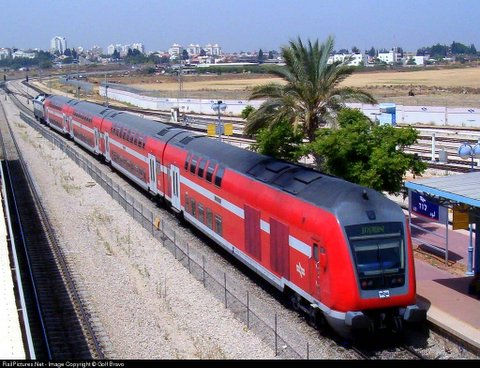
Railway to Eilat now in the works


The track will connect to the existing line that leads from Beersheba to Dimona and include eight new stations along the way.
The Transportation Ministry published a Request For Information (RFI) on Monday to gauge the private sector’s interest in building a railroad to Eilat.
The publication of the RFI is the first step toward finding a company to take on the role of building the 170-kilometer track from Dimona to Eilat.
According to the Transportation Ministry, the new railway will include 63 bridges and five tunnels.
The track will connect to the existing line that leads from Beersheba to Dimona and include eight new stations along the way, including a station at the as-yet-unbuilt airport in Timna.
Travel time from Tel Aviv to Eilat is expected to take two-and-a-half hours by rail, and it is estimated that the line will cater to 3.5 million passengers per year.
According to the ministry, the track will also carry freight containers from the port of Eilat to the rest of the country and assist in reducing truck transport across the country, freeing up the roads, reducing pollution and reducing accidents.
Transportation Minister Yisrael Katz said the Eilat rail project also held social significance and that its construction would bring residents of the periphery closer to the heart of the country.
“This is a plan that will significantly reduce travel times from the Center to Eilat and create a significant change in Israel’s transportation map,” said Katz.
The railroad to Eilat is part of the government’s transportation reform plan, in which NIS 2.5 billion has been earmarked for planning new roads and railways.
According to the Transportation Ministry, the new railway will include 63 bridges and five tunnels.
The track will connect to the existing line that leads from Beersheba to Dimona and include eight new stations along the way, including a station at the as-yet-unbuilt airport in Timna.
Travel time from Tel Aviv to Eilat is expected to take two-and-a-half hours by rail, and it is estimated that the line will cater to 3.5 million passengers per year.
According to the ministry, the track will also carry freight containers from the port of Eilat to the rest of the country and assist in reducing truck transport across the country, freeing up the roads, reducing pollution and reducing accidents.
Transportation Minister Yisrael Katz said the Eilat rail project also held social significance and that its construction would bring residents of the periphery closer to the heart of the country.
“This is a plan that will significantly reduce travel times from the Center to Eilat and create a significant change in Israel’s transportation map,” said Katz.
The railroad to Eilat is part of the government’s transportation reform plan, in which NIS 2.5 billion has been earmarked for planning new roads and railways.

PR invites South Korean railways to operate its five trains


Pakistan Railways has invited South Korean Railways to operate its five trains on various routes that are running in deficit, General Manager Operations, Ishfaq Khataq told media here at the PR Headquarters on Monday.
He said South Korean Railway experts have agreed to train Pakistan railway staff and help restore infrastructure of the under-utilised railway network.
Earlier, South Korean railway delegation met with PR officials at the Railways headquarters and discussed various proposals to bring improvement in Pakistan Railways. Khataq said that Pakistan Railways needs at least 200 locomotives as early as possible to resume its normal operations and play its vital role in the economic development of the nation.
South Korea has offered us six locomotives of 3000 horsepower capacity, which is quiet insufficient, he added. After checking their performance we will precede further to upgrade our system GM further added. He said Pakistan railways has offered the South Korean Railways to run its trains on five routes with open access policy. South Korean trains will operate on Lahore-Faisalabad, Lahore-Gujarat-Gujranwala, Lahore-Kasur and Wagha routes. He said that delegation would soon send feasibility report regarding trains operation.

Sapsans will run to Kiev, Yekaterinburg and Irkutsk at 300 km /h


High-speed railway for Sapsan trains will connect Moscow with Yekaterinburg and further, with Irkutsk. The trains will travel along it at 300 km/h and more. Most probably they will be Sapsan trains, which are supposed to be constructed in Russia, in co-operation with Siemens.
This route, Moscow - Nizhniy Novgorod - Yekaterinbug will have diverging branch lines to big cities of the Urals like Perm, Ufa, Chelyabinsk, Tyumen and Nizhniy Tagil. This project includes construction thousands kilometers of new special railtracks, stations, other engineering structures and of course, trains. It will take time, moreover, it costs 2 trillions rubles, but it seems to be worth it. 
It was also reportes, that Sapsans will run between Moscow and Kiev, and maybe in the nearest future.

source: Russia Info Centre

Tuesday, November 23, 2010

China plans SE Asia rail links


China is planning high-speed rail links with its Southeast Asian neighbors, namely, Myanmar, Cambodia, Thailand and Laos, and further expand its economic and strategic regional influence.
China's national rail network, which is already the world's biggest, will reach 120,000 km by 2020. Sixty percent of the railway lines will be located in the western regions, which have historically lagged the coastal east on most development indicators.
In two months, work will begin on a 1,920-km high-speed rail line connecting south-western Yunnan province with Yangon in Myanmar, with trains running at over 200 km/h, the official China Daily reported on Monday.
Studies were also under way to link Yunnan's capital Kunming with Cambodia, Laos and Vietnam, the daily quoted Wang Mengshu, one of China's leading railway consultants, as saying.
In August, China's Ministry of Railways also sent a team to Thailand to explore investing in a $25.6 billion, 240-km high-speed railway and rail network.
Wang had earlier said that the Southeast Asian network could be completed as early as 2020.
Authorities in Beijing hope the investment in Southeast Asia will also ease anxieties among its ASEAN (Association of Southeast Asian Nations) neighbors over the impact of China's rising economic influence.

source: Press tv

JR Tokai vies for Florida rail system


NAGOYA (Kyodo) Central Japan Railway Co. (JR Tokai) plans to apply for prebidding screening to build a high-speed railway system in Florida, company officials said Monday.
The railway will join forces with 11 other Japanese firms so it can gain an advantage over its European and Asian rivals in pitching its shinkansen system, they said. The application is likely to be submitted this month.
The company wants the contract in Florida to act as a springboard for expanding the shinkansen system globally. Florida plans to construct a 130-km rail line between Tampa and Orlando at a cost of more than $2 billion, or about ¥160 billion. The project is getting federal funding.
Florida is expected to start prebidding screening this month to appraise the technical capabilities and finances of the bidders, which are expected to include companies from Germany, France, South Korea and China. It will likely narrow down the field to four groupings by February, before formally accepting bids around next summer.

source: Japan Times